


Contact: Madeline Myers, Public Relations and Communications Specialist
330-474-5032
Press release images available at pbswesternreserve.org/press/photos
FOR IMMEDIATE RELEASE
New PBS Western Reserve Documentary Explores Devastating 1913 Ohio Flood
“Northeast Ohio & the Great Flood of 1913" to premiere Friday, Nov. 7, at 9 p.m. on PBS Western Reserve
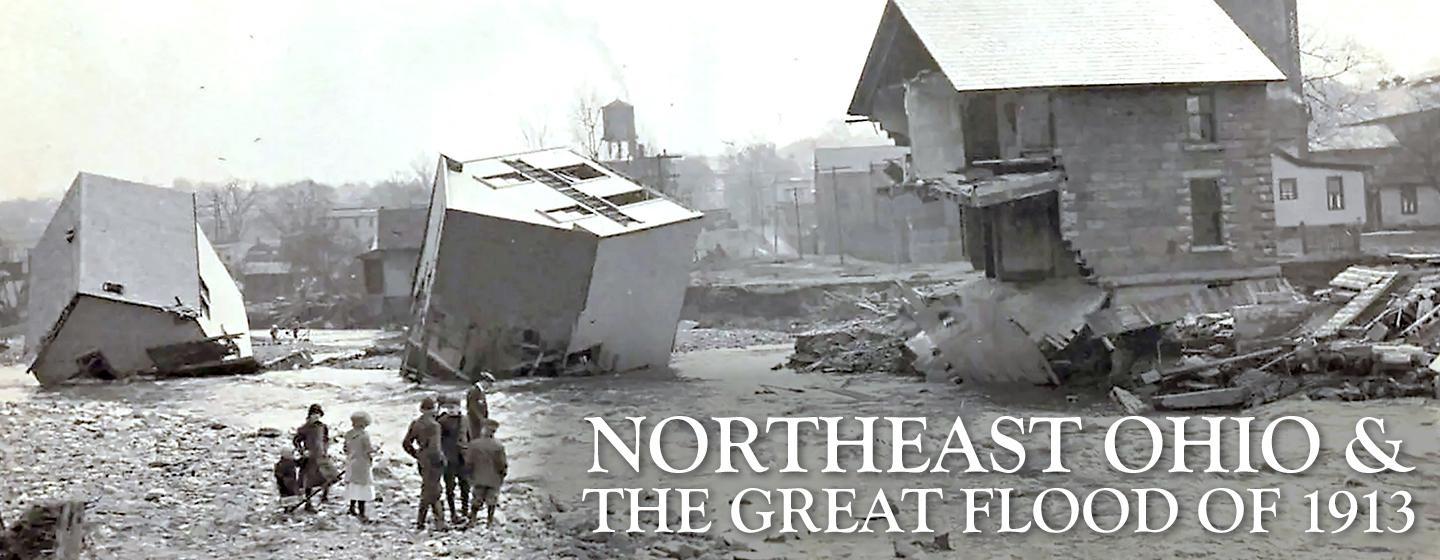
Kent, OH — Oct. 27, 2025 — A new history documentary from independent producer Fred Endres, “Northeast Ohio & the Great Flood of 1913,” chronicles the story of the Great Flood of 1913 and its devastating impact on Northeast Ohio. It will premiere on PBS Western Reserve on Friday, Nov. 7, at 9 p.m.
The weather in Northeast Ohio on Easter Sunday in 1913 was supposed to be generally fair and cool, but as folks left church that Easter morning, a steady, chilly rain started, ruining bonnets, dresses and suits. The rain did not stop.
Over a four-day period, up to a foot of rain fell across Ohio — what came to be known as “the great Ohio flood.” The storm remains the worst weather disaster in the history of Ohio. While the southern part of the state was hit the hardest, Northeast Ohio was not spared from the damage, devastation and death.
Estimates of the number of people killed in the flood vary from around 350 to more than 500, but many historians today believe those numbers are too low. The U. S. Geological Survey put the damage in Ohio at $143 million, about $4.5 billion in today’s money.
“Just about every city and town in Ohio suffered damages during the storm,” Endres said. “We focus on Akron and Kent in the documentary, and they tend to be fairly representative of what happened in other areas in Northeast Ohio.”
The program includes dozens of photographs of the flood and flood damage in Akron, Kent and other nearby towns. Endres said he was amazed at the number and quality of images available through such organizations as the Akron-Summit County Public Library, Kent State University, the University of Akron, the Summit County Historical Society and the Barberton Public Library.
Endres thanked the local librarians and archivists. “They are unsung heroes. They do an extraordinary job in finding and sharing their holdings,” said Endres.
Endres has written and produced several other documentaries that have appeared on PBS Western Reserve, including “The ‘Sojer Boys’ of Portage County”; “Akron, Ringling & the ‘Blue Heaven’ Circuit”; “Seances & Slot Machines: The Story of Brady Lake Park”; and “Under Fire, Under Siege: Strikebreakers in Kent, Ohio.” He is also a professor emeritus from the School of Media and Journalism at Kent State University.
Following its broadcast premiere on PBS Western Reserve (WNEO 45.1 / WEAO 49.1), “Northeast Ohio & the Great Flood of 1913” will be available on demand via the PBS Western Reserve website, PBS App and YouTube.
About PBS Western Reserve
PBS Western Reserve is a community organization that empowers Northeast Ohio and Western Pennsylvania through the impact of accessible public media and educational services to foster connection and lifelong learning. We present to our region cultural, scientific and artistic programming for awareness and enjoyment; local storytelling and access to trusted regional, state and national public affairs; experiential opportunities and community outreach for people of all ages; and educational initiatives that support the healthy development of our youth.
PBS Western Reserve is made up of two separately licensed public television stations (WNEO and WEAO) and an Educational Services division operating under one 501(c)(3) nonprofit corporation, Northeastern Educational Television of Ohio Inc. (NETO). WNEO was established in 1971, is licensed to the city of Alliance and serves the Youngstown designated television market. WEAO went on the air in 1975, is licensed to the city of Akron and serves the Cleveland-Akron-Canton designated television market. All programming is simulcast on the two stations.
##